




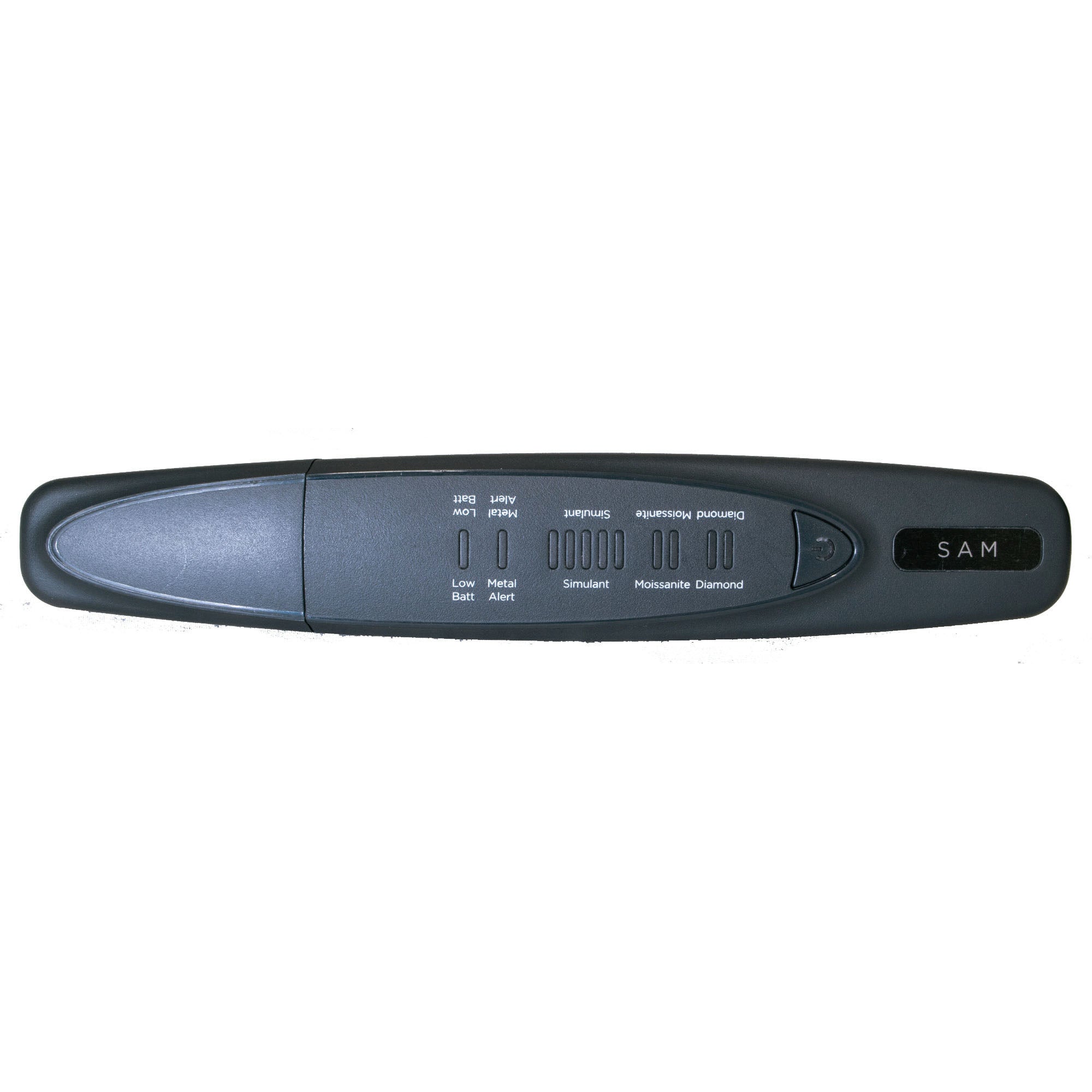
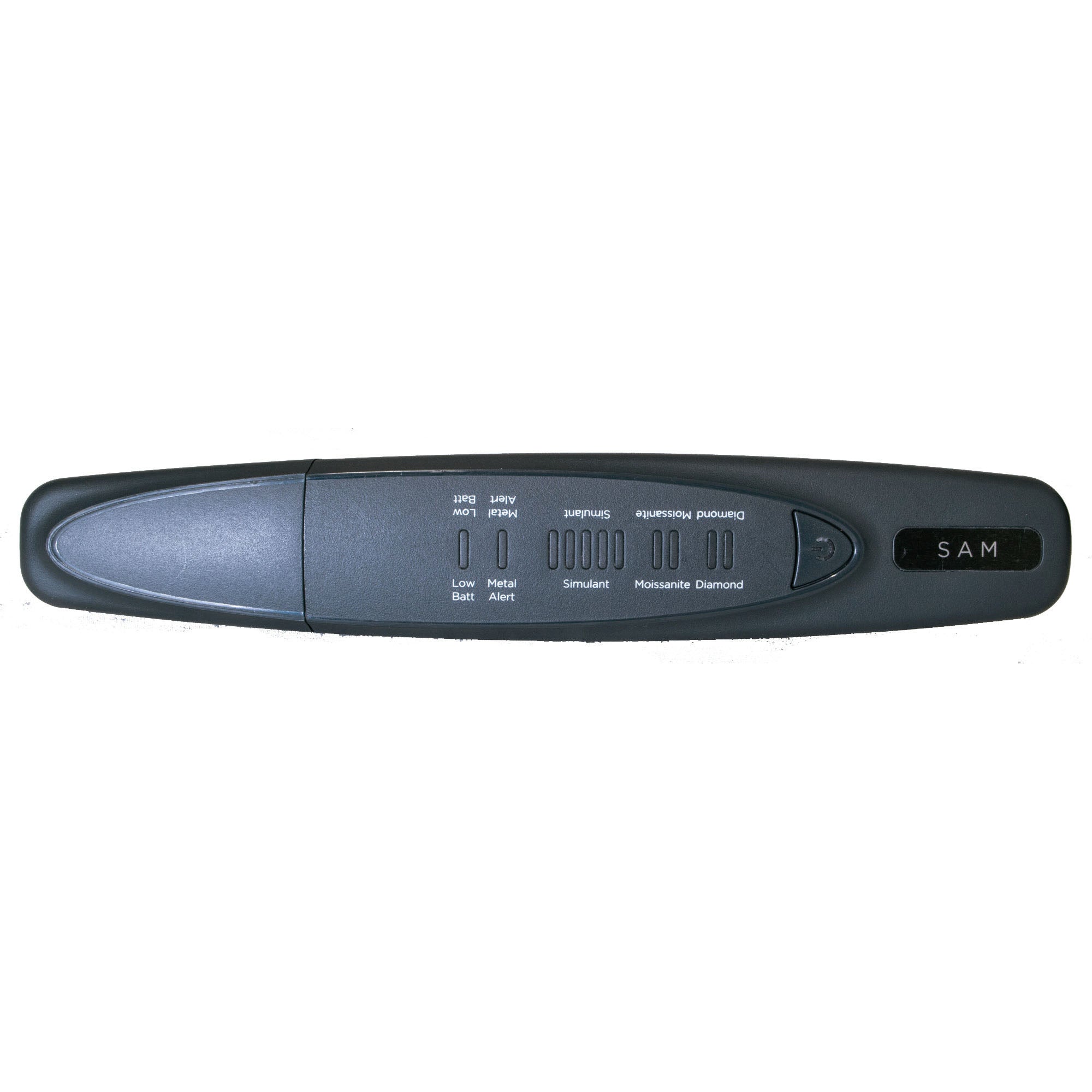
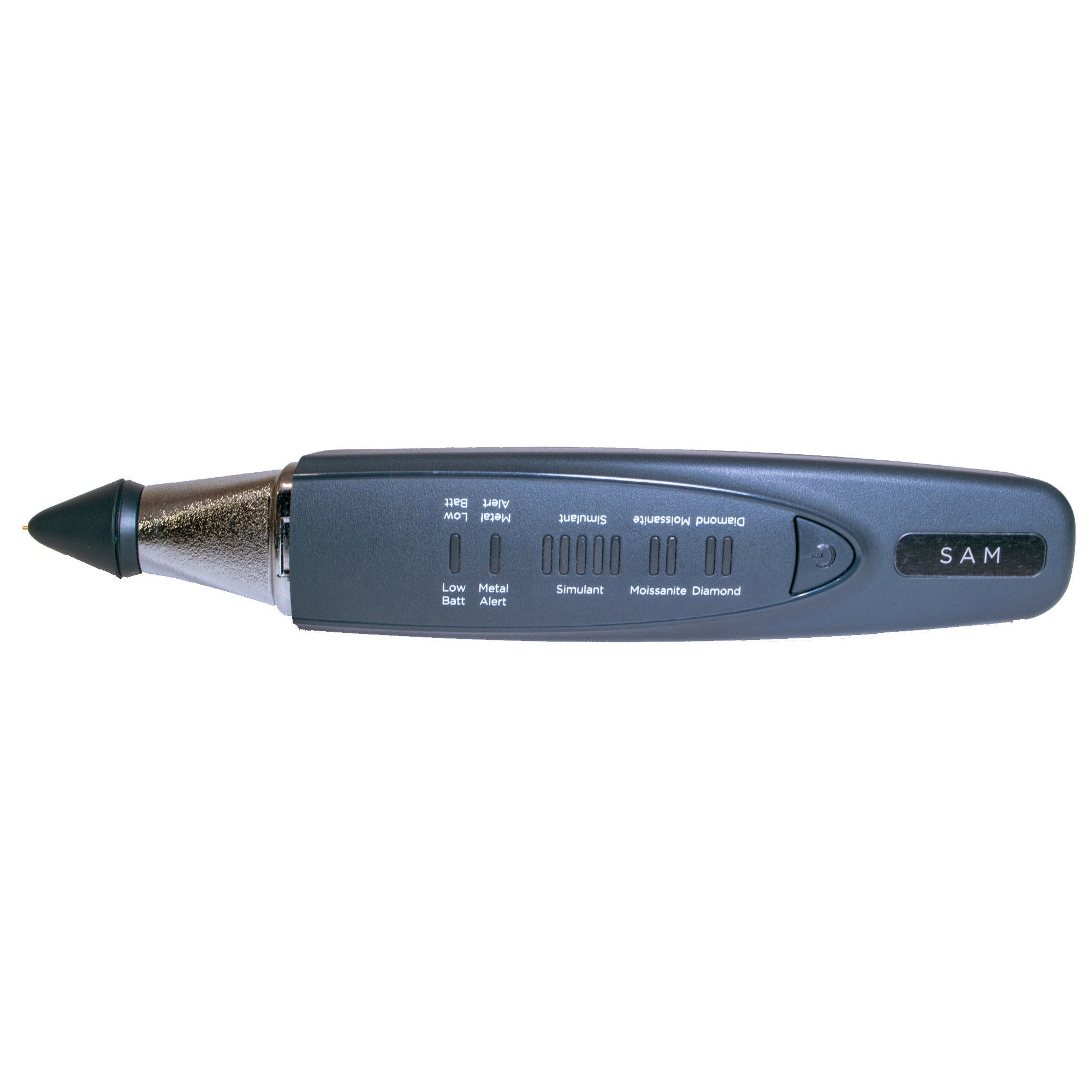
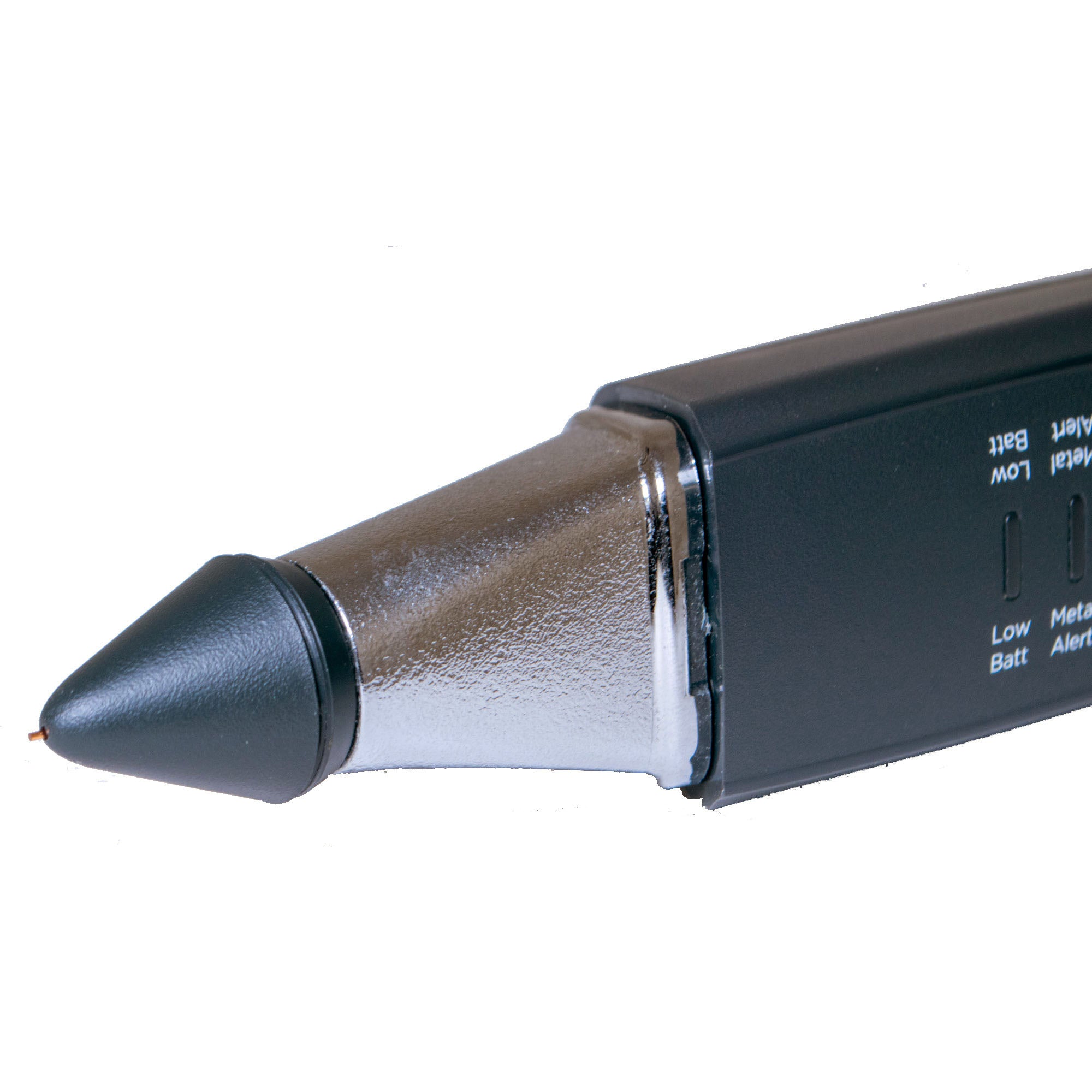
SAM multi-tester
- Vendor
- Unit price
- per
(Single item price excluding VAT: £290.83)
Why buy from us?
Pickup available from Quicktest (WD18 8JA)
Email us
or call on 01923-220206 for appointment.
Summary
This is the best multi-tester for working in 'extreme' conditions such as in the heat or in the cool. If you want a tester that works in the widest range of temperatures (especially if you are going to be using it in a hot country) this is the most reliable.
- fastest response time (test-result in 1 second)
- left-handed or right-handed use
- thinnest probe (0.45mm) tests stones as small as 0.01 carat (1 point)
- can be used with batteries (included) or USB power (cable not included)
- in its case it's smaller an neater than other diamond testers.
- one year guarantee.
Every diamond tester ever made has its limitations. For standard diamond testing see our article Guide to Buying Diamond Testers. None of these can distinguish natural (mined) diamonds from synthetic (lab-grown) diamonds, both are diamond - for these you will require a specialist tester, see Testing for Synthetic Diamonds. Synthetic is not to be confused with simulant which is "anything you may think looks like diamond even though it isn't" - for which standard testers such as the SAM are designed.
Technical
Size 170mm (6.69 inches) X 31mm (1.2 inches) X 28mm (1.1 inches)
Weight 55g (1.94 oz)
Tests stones from 0.01 to 10 carats incl. mounted stones in any setting
Operating temperature 18 to 27 degrees C (64 to 81 degrees F)
Start-up time 10 seconds
Testing time 1 second
Warm-up time between tests 2 seconds
Power: three AAA batteries (supplied) or any USB power source (USB cable not supplied). NOTE: the USB cable is to power the tester directly, it does not charge batteries. Also, IF you use rechargeable batteries they must be lithium, not the standard NiMH.
Battery life: 2000 continuous tests with good quality alkaline batteries, eg Duracell
Auto-power-off yes, if used on battery power it turns itself off after 10mns with no activity.
Guarantee: 1 year
Low battery indicator: yes
ACCESSORIES / PRESENTATION
Neat heavy-duty carrying pouch
Summary of instructions (you are meant to download the full instruction booklet).
Limitations
Will not test fancy-coloured stones; no 'low batt' indicator; synthetic diamonds (not to be confused with simulants!) usually register as Moissanite; the Moissanite test is very sensitive, both stone and test-tip must be 100% clean and grease-free, you will cover the stone in a layer of grease simply by touching it with your finger (this is a 'limitation' for anyone expecting a quick-easy-accurate test).
Video
Disclaimer
All testers must be used in conjunction with the user's skill, knowledge and experience. Under no circumstances shall QUICKTEST be liable for direct or indirect loss sustained in connection with any item. Nothing is 100% accurate, you must understand the limitations of any tester. We also suggest you regularly test known samples to check for any obvious faults.
ALTERNATIVES
The testers below are to distinguish diamond from non-diamond (simulant/imitation); they do not include the very specialist testers that distinguish natural diamond from synthetic diamond, see the ARI, ARETE and APEX. "Synthetic" is a scientific term meaning 'made by man in a factory/laboratory to the same formula found in nature' (read all about it).
|
Model |
Tests mounted stones [1] |
Tests Diamond |
Tests Moissanite |
Tests |
Other stones |
|
Diamond selector II, (DT-DS-crp) (works some of the time) |
✔ | ✔ | Shows up as diamond | ✘ |
No reaction on non-diamond |
|
Diamond selector II (DT-DS) |
✔ |
✔ |
Shows up as diamond |
✘ |
No reaction on non-diamond |
| Diamond Experior (best diamond-only tester) | ✔ | ✔ | Shows up as diamond | ✘ | Non-diamond reads 'Other Stone' |
|
✔ |
✘ |
✔ |
✘ |
You must only test stones you are certain are diamond |
|
|
✔ |
✔ |
✔ |
✔ |
No reaction on other stones |
|
|
✔ |
✔ |
Shows up as diamond |
✔ |
31 stones |
|
|
✔ |
✔ |
Shows up as diamond |
✔ |
17 stones |
|
|
[2] |
✔ |
✔ |
✔ |
[3] |
|
|
✘ |
✔ |
✔ |
✔ |
55 stones |
|
|
✘ |
✘ |
✘ |
✔ |
Hundreds of stones [4] |
[1] All testers test loose stones but not all can test mounted (set in jewellery) stones.
[2] The probe / analogue meter will test mounted stones, the digital meter will only test loose stones.
[3] The probe / analogue meter: 17 stones; the digital meter: 40 stones.
[4] Skill and practice is required to use an optical refractometer, instructions are not included, see any textbook about gemmology…or the internet.