


All About Ultra Violet Testers
Ultra violet (UV) light. How it works. What you can do with it. Test-results in pictures.


CONTENTS
USING UV LIGHT TO CHECK ANTIQUES
SPECIALIST USES. UV LIGHT IN NATURE.
THE FOUR QUESTIONS
TECHNICAL EXPLANATION OF UV LIGHT
SAFETY
PHOTOS: GENERAL EXAMPLES
PHOTOS: PRODUCTS IN USE
USING UV LIGHT TO CHECK ANTIQUES
To go straight to the photographs showing examples of what you see under UV lights, scroll down quite a long way or click here.
Ultra violet light (known in the U.S.A. as 'blacklight') is a very intense blue light, it is not visible to the human eye. Fluorescent-tube UV torches give off a very dull purple or violet glow. LED UV torches give off a dull lilac-blue. But the actual UV light is invisible, so the only way you can tell how effective it is - is to observe its effects.
When porcelain is repaired and the missing part is 'rebuilt' (or the crack glued) it is then carefully repainted so that the colour matches. The colour will match perfectly in white light (e.g. daylight) but under UV light the new paint shows up a totally different shade. This applies to many decorative items, watch dials, dolls heads, faint signatures on letters, modern touch-up paint on old paintings. A similar effect can be seen on cars parked under a yellow street lights, touch-up paint appears quite a different shade, whereas in daylight it matches perfectly.
Here are some other examples from the world of antiques and art:
|
APPEARANCE UNDER UV LIGHT |
INDICATES |
|
OIL PAINTINGS Bluish-white Dark bluish-violet Chartreuse glaze Very small blue dots Dark blotches Bright yellow |
Picture putty Old varnish Dust Repairs, new signatures & overpainting Recent touch-up with white lead or Naples yellow |
|
ART ON PAPER Bright areas Smudged areas Very faint writing
|
New patches of paper Erasers Erased signature |
|
MARBLE Strong purple Mottled white
|
Fresh cut Old marble |
|
JADE Intense colour Mottled |
Fresh carved Old jade |
|
IVORY Purple Yellow tone
|
Newly carved Old ivory |
|
AMBER |
Some amber does fluoresce under UV light (notably blue amber) but so too will many substances so this test is not diagnostic. The one reliable test for amber is destructive, which is never recommended. Touch the tip of a red-hot needle to it. If the burning smells acrid (like plastic) then it's plastic; if the burning smells sweet, it's amber. Failing the burn-test, the best test is to drop it into heavily-salted water, amber will float whereas GENERALLY plastics sink. But there are many thousands of different plastics and we doubt that anyone has compared them all with amber, there are certain to be some exceptions. |
|
Uranium glass |
Glows spectacularly. |
How does it work? It works by reflecting off the surface and showing up the difference in the chemical composition of the paint, or by showing characteristics of the item's basic chemical make-up.
SPECIALIST USES. UV LIGHT IN NATURE.
Many everyday substances glow under UV light: chlorophyll, teeth, antifreeze; olive oil, honey, ketchup; some cosmetics, some drugs, some flowers, most postage stamps, most banknotes.
There is starch in ordinary paper that makes it glow a vivid blue under UV light, but the old paper banknotes (which were made of a linen-type material, not paper) merely looked 'slightly blue'. Today, plastic banknotes are printed with 'secret' marks using UV-ink, which can only be seen under UV light.
Additives in soap powders glow under ultra violet light, they are added for that very reason: UV light in daylight makes your white washing glow blue-white, which is why advertisers once used the catch line, 'washes whiter than white'.
Quinine is an ingredient of some drinks (e.g. tonic water), it gives them a distinctive bitter taste. Quinine glows under UV light. So the next time you are in a dimly-lit bar drinking a gin and tonic, shine your UV torch on it and see it glow.
Paint / ink
Objects painted with UV paint / ink will be invisible under ordinary light but will glow under UV light. Uses:
- security-marking: e.g. with your postcode
- finding things in the dark: gold balls, tortoises, keys
- fun: makeup / face painting, spooky decorations
- theatre and dance: dim the lights, light the stage with UV light, objects can appear to float in mid air, people can appear headless
- leak detection: in car radiators and central heating systems, slow leaks (which don't appear wet) leave behind a residue that glows under UV light
Specialist Uses
- cross linkers and light boxes for viewing gels in biological laboratories
- germicidal UV lights for treating food before it goes on sale in the supermarkets
- welding operations
- curing uv-sensitive adhesives or uv-sensitive nail varnish ("gel-varnish")
- in pipes carrying water to fish tanks or fish ponds to kill algae and bacteria
- to help identify some minerals and gemstones
- freshly-spilt blood and urine can fluoresce under a powerful UV light, used by the the forensic services at crime scenes.
Medical, food and industrial
- checking major skin wounds before operating, to show up bacteria (e.g. porphyrin molecules in the bacteria fluoresce red or blue-green under 405nm light). The presence of bacteria does not necessarily indicate an infection, the area must then be swabbed for further analysis.
- checking laboratory equipment after cleaning, UV can show up bacteria (we sold several of the UV-1 to a pharmaceutical company for this purpose)
- treating minor skin wounds, though there is a balance, here, between the benefit of stimulating healing and the risk of causing cancer, because they use short wave UV torches (which we don't sell).
- a dairy bought some UV lights from us for checking their steel containers when empty, the UV makes any remaining milk or cream fluoresce.
- equipment carrying oxygen must be kept meticulously clean to avoid the risk of fire. There are specialist methods of detecting contaminants (e.g. Fourier Transform InfraRed spectroscopy or Energy Dispersive X-ray spectroscopy) but it's a good to start with something simpler: visual inspection under UV light. This will detect many (not all!) oils and greases and also lint and dust.
Animals and plants
Humans need UV light (from sunlight) to produce vitamin D in the skin (nearly everyone in Northern Europe is vitamin-D-deficient in the winter due to lack of sunshine); in the summer it's popular to take advantage of prolonged UV light from the sun to burn the skin (it's called a suntan) - and if there's no sun there are tanning parlours in which you can be gently grilled under giant UV lights. Over-exposure to UV light can cause cancer but some exposure is essential. To get enough UV light, go out in the sun (without sun cream) whenever possible but don't stay out long enough to get a tan.
In humans, the lens of the eye filters out UV light so that we cannot see it, but some people who have had eye operations (e.g. following a cataract operation) can see UV, they see a bluish or purplish glow that is invisible to most people. An example of this is in the paintings of water lilies by Monet following his cataract operation.
Until recently it was thought that just a handful of animals could see UV light. It now seems that a great many can: many fish, reptiles and birds, and most mammals (though not primates). For instance, Kestrels can detect the urine trails of prey. For reindeer living in the Arctic urine appears black against the ice and snow as it absorbs UV light (urine is bad, it indicates nearby predators) whilst lichens appear white (lichens are good, reindeers eat them).
For humans, the only way to see the effect of UV light is to use a UV torch. For instance, to detect lichen, shade it from bright daylight, shine a UV light on it, and see if it fluoresces white, bluish or orange - if so, it's probably lichen (try it out on Cladonia portentosa).
THE FOUR QUESTIONS
Here are four questions we get asked about UV light.
Q: so why do some UV lights appear really bright and others appear really dim?
A: many popular UV torches are 'popular' because they appear 'really bright', but the amount of actual UV light (which is not visible to the human eye) is very small, and its effect is very slight...to the point of being useless. By contrast, some UV torches appear dim to the human eye, but the amount of actual UV light is large and they work well. So when you look at all our UV lights, that is the main difference between one that costs £5.90 and one that costs £59.00.
Q: do I have to use a UV torch in the dark?
A: the effect is certainly spectacular if you go into a completely dark room, but usually it is sufficient to use it in dim light. Shade the item under a square of dark cloth, or the underneath of a table in a dim corner or even the inside of your jacket (you may have seen antiques dealers lifting their jacket and, it would seem, examining their armpit with a blue light). UV lights used in shops for testing banknotes include a shade. All this is no different from using an ordinary torch, turn it on outside in bright sunlight and you won't see any effect.
Our best models give out a huge amount of UV light and can be used in daylight, though not in direct sunlight. All UV lights work best in dim light, the dimmer the better.
Q: can't I just use a torch with a more powerful UV light, so that I don't have to use it in 'dim' light?
A: To an extent - yes. But it depends on the type (wavelength) of the light, if it is wrong (as with many cheap UV torches) then it won't work, no matter how powerful. Providing the type (wavelength) is right, then yes, a larger more powerful UV torch will light up a wider area and work in brighter light, just the same as an ordinary torch. Scroll down or click here for recommendations.
Q: if I use it by shining the light on the surface of an antique, does that mean that it won't see below the surface?
A: Exactly so! If the item has been repaired and then re-glazed, a UV torch will be of no use, there will be no 'new' paint to see, the entire surface will be new. Similarly, you cannot see through layers of paint to see 'hidden paintings', UV light is not the same as x-rays. But you can see differences in surface paint, and that can indicate that a painting has been 'touched up'. Similarly, if a signature reacts differently to the surrounding work, it's clearly made of a different ink/paint and may have been added.
Q: how do I see below the surface, e.g. to see an original drawing underneath a painting?
A: there are now a few ways of doing this, but none involve a simple UV light. For instance, by examining the fluorescence caused by x-rays rather than UV rays (XRF, x-ray fluorescence), or by analysing how specific wavelengths (colours) are reflected.
TECHNICAL EXPLANATION OF UV LIGHT
As you see from the chart below, the electromagnetic spectrum ranges from AM at one end (which includes Medium Wave and Long Wave radio) to Gamma Rays at the other. The measurements on the right of the chart, below, are the length of each wave section (from peak to trough) in nanometres (nm). 1nm = 0.000001mm.
"Visible light" falls between microwaves and x-rays.
UV light, although close to x-rays, cannot penetrate the human body, its effect (for shortwave UV) is limited to burning the surface of skin (though it can cause damage to the eyes). Having your skin burnt by shortwave UV light is very popular, it's called 'getting a suntan'.
The tiny band we call 'visible light' ranges from infrared (the human eye can't detect far-infrared) to ultraviolet (the human eye can't detect ultraviolet):

The tiny part of "light" we call UV LIGHT ranges from 400 to 700nm.
For the sake of applications (what you can do with UV light) and for the sake of safety (which wavelengths are harmful) we like to split the range of UV light (250 to 400nm) into three groups:
"Longwave" UV, also known as UV-A, 400 to 300nm
"Midrange" UV, also known as UV-B, 315 to 280nm
"Shortwave" UV, also known as UV-C, 280 to 250nm
These numbers are approximate, there's nothing to distinguish the boundary from one to another.
UV light is invisible to the human eye, the UV torches you buy also give out some visible light and it is this you can see as a dull glow. Manufacturers of the cheaper torches ensure that the 'dull' glow isn't too dull, so that the user says, "Wow, this UV torch is so powerful!". Giving out some visible light is, of course, useful, otherwise you wouldn't know if your UV torch was switched on or off.
All the UV torches we sell are UV-A / longwave, they are not shortwave (shortwave burns skin and can damage eyes) but we do have one shortwave light encased in a 'safe' viewing box (UV-SW). Scroll down to see photos showing how the many UV torches (various wavelengths and powers) compare.
SAFETY
UVA. All our UV torches are UVA (see above). It is quite safe to point these at the skin, there is no way this type of UV can burn skin. However, please do not stare directly into the light.
UVB and UVC can burn the eyes or skin. When used in sun beds they are specifically designed to burn (tan) the skin but the user must wear dark glasses to protect the eyes. Prolonged exposure (e.g. too much sunbathing) can lead to skin cancer. We do not sell UVB or UVC torches.
Susceptibility to skin being burnt by UV light depends on skin colour. Brown-skinned people are less sensitive to being burnt by UV light, melanin in the skin provides protection; completely black-skinned people have a variation, eumelanin, which gives even greater protection. This dates from a time when humans spread northwards from Africa to lands where there wasn't much sunshine, fair skin evolved; it evolved so that people were more sensitive to UV light, because UV light is necessary for producing vitamin D in the skin.
PHOTOS: GENERAL EXAMPLES
As you keep scrolling down, you will see photos taken under each of our UV lights at various distances and in various lighting conditions. But first, here are four general examples (click/tap on each picture to see it enlarged).
Here is banknote, a cheque and a stamp in ordinary light:

Here is the same under a poor quality UV light. Sure, it works! You can see the number on the cheque, you can see a faint band on the stamp, you can (just about) see the "5" on the bank note:

And this is what it looks like under good UV light:

Here is a small dish made of Uranium Glass, it's a nice tasteful pale green under ordinary (white) light:

Under a good UV light it glows spectacularly (though this doesn't show up very well in a photo):

Many gemstones fluoresce under UV light. If you're going for a magnifier with a UV light, be extra careful which one you buy. Below are two sets of photographs showing a ruby, one set taken with an unbranded 10X loupe with UV light (the size of the magnifier happens to be 10X21), the other set of photos were taken the QUICKTEST 10X20 loupe with UV light. The QUICKTEST loupe also has a rim of ordinary (white) light, you push the switch one way for white light, the other way for ultra violet light.
For a closer view, click on each of the two images. The top right photo in each set is under the loupe's white light; the bottom right photo is under the loupe's UV light.
First and unbranded loupe with a really bright (to the human eye) rim of UV lights, look at the ruby under UV light (bottom right):

By contrast, our QUICKTEST 10X20 loupe with UV light has just one tiny UV light but look (bottom right) at how the ruby glows:

Please note that using ultraviolet light is not a 'test' for ruby, because some ruby (especially Burma ruby) fluoresces brilliantly, some ruby does not fluoresce at all; the above is just to show you the difference between the quality of ultraviolet lights.
This watch dial does not have 'luminous' paint. Instead, it has tiny glass tubes filled with a radioactive liquid. In ordinary (white) light it looks like this:

...and it pitch dark it will appear like this, even after a few hours, when standard 'luminous' paint will not work:

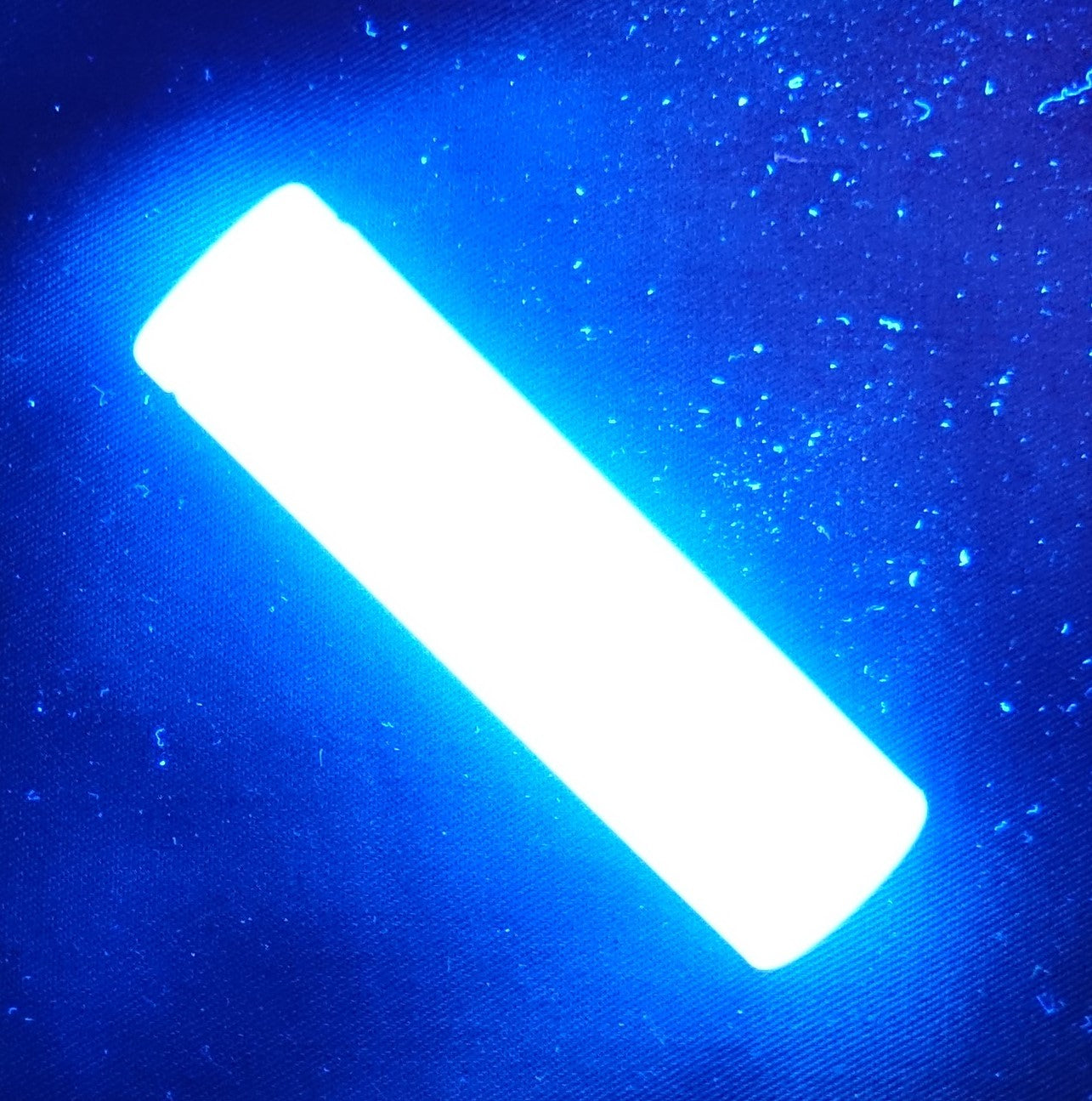
Finally, this is a simple plastic tube. And what is it filled it with? A highly radioactive substance? No! It's filled with tonic water. First under ordinary (white) light:

...and now under UV light (difficult to photograph, it's more spectacular in real life):
PHOTOS: PRODUCTS IN USE
To make the pictures larger on a desktop, hold down control and use the scroll on the mouse.
UV1-3 (3 WATT)
£27.50

Wavelength 365nm
Power 3W
Details
Firstly, without UV light, under bright fluorescent office lights. There's some reflection off the shiny part of the note but, with no UV light, nothing extra to see:
UV-3W-ZOOM UNDER BRIGHT OFFICE LIGHTS (no daylight, no sunshine): -
UV1-3 at 10 inches away:

UV1-3 at 1m away:

IN VERY DIM LIGHT (no lights on, no daylight, but not completely dark, some light seeping in from the neighbouring office):
UV1-3 at 10 inches away:

UV1-3 at 1m away:

UV1-3 at 2m away: 
UV-1-3W-ZOOM

Wavelength 365nm
Power 3W
Details
Firstly, without UV light, under bright fluorescent office lights. There's some reflection off the shiny part of the note but, with no UV light, nothing extra to see:
In the following are see examples with the torch set to its widest wide angle and its narrowest spotlight.
There are lots (12) photos, so if you are not interested in this product, keep scrolling down to the next product.
UV-3W-ZOOM UNDER BRIGHT OFFICE LIGHTS (no daylight, no sunshine):
At 10 inches away, with the zoom set to its widest 'wide angle': -
...and the same with the zoom set to its narrowest ’spotlight’: -
UV-3W-ZOOM at 1m away, with the zoom set to its widest 'wide angle': -
...and the same with the zoom set to its narrowest ’spotlight’: -
UV-3W-ZOOM at 2m away, with the zoom set to its widest 'wide angle': -
...and the same with the zoom set to its narrowest ’spotlight’: -

IN VERY DIM LIGHT (no lights on, no daylight, but not completely dark, some light seeping in from the neighbouring office)
At 10 inches away, with the zoom set to its widest 'wide angle': -

...and the same with the zoom set to its narrowest ’spotlight’: -

UV-3W-ZOOM at 1m away, with the zoom set to its widest 'wide angle': -

...and the same with the zoom set to its narrowest ’spotlight’: -

UV-3W-ZOOM at 2m away, with the zoom set to its widest 'wide angle': -

...and the same with the zoom set to its narrowest ’spotlight’: -

UV-KR-2 £5.90

Wavelength, unknown
Power, unknown
Details
Firstly, without UV light, under bright fluorescent office lights. There's some reflection off the shiny part of the note but, with no UV light, nothing extra to see:-
UV-KR-2 IN VERY DIM LIGHT (no lights on, no daylight, but not completely dark, some light seeping in from the neighbouring office):
UV-KR-2 at 4 inches away. You can see the "5" but it's not very bright (though it does work fine at about 1 inch away, no photo): -

UV-KR-2 at 10 inches, 1m and at 2m
- no photos, it doesn't work at these distances.
UV-KR-2 UNDER BRIGHT OFFICE LIGHTS (no daylight, no sunshine): -
- if it's not too bright, it works at about 5mm.
UV-1-5 (5 watt)
£42.50

Wavelength 365nm
Power 5W
Full details
Firstly, without UV light, under bright fluorescent office lights. There's some reflection off the shiny part of the note but, with no UV light, nothing extra to see:-
IN VERY DIM LIGHT (no lights on, no daylight, but not completely dark, some light seeping in from the neighbouring office):
UV-1-5 at 10 inches away:
UV-1-5 at 1m away:
UV1-15 (15 watt)
£32.50
Wavelength, 365nm
Power, 15W
Details

Without a doubt the most powerful.
1 LED, Wavelength: 365nm.
Firstly, without UV light, under bright fluorescent office lights. There's some reflection off the shiny part of the note but, with no UV light, nothing extra to see:-
UV1-15 UNDER BRIGHT OFFICE LIGHTS (no daylight, no sunshine):
UV1-15 at 10 inches away:
UV1-15 at 1m away:
UV1-15 at 2m away:

UV1-15 IN VERY DIM LIGHT (no lights on, no daylight, but not completely dark, some light seeping in from the neighbouring office):
UV1-15 at 10 inches away:

UV1-15 at 1m away:

UV1-15 at 2m away:

UV-100 £32.50

Wavelength approx. 390-395nm
Output, unknown but it is (to the human eye) the brightest you will ever see.
Although, as you see from the photos, this isn't best for the amount of UV light (invisible to the human eye) it gives out, it is the best to use on gemstones to improve the accuracy of simple diamond testers.
Full details
Firstly, without UV light, under bright fluorescent office lights. There's some reflection off the shiny part of the note but, with no UV light, nothing extra to see:-
UV-100 UNDER BRIGHT OFFICE LIGHTS (no daylight, no sunshine): -
- UV-100 at 10 inches away:

UV-100 at 1m away:

UV-100 IN VERY DIM LIGHT (no lights on, no daylight, but not completely dark, some light seeping in from the neighbouring office):
Ignore the difference in overall brightness in these particular photos (different camera settings) and look at the effectiveness.
- UV-100 at 10 inches away:
- UV-100 at 1m away:
UV-100 at 2m away:
UV-SW £52.50

Place the sample under the light), and you view the item through the magnifier, inside the box, so it doesn't have to be used in dim light. It's eye-safe (you can't look directly into the shortwave light, which would damage your eyes). For small objects, especially gemstones and small mineral samples, because some react to LW UV light and SW UV light.
UV (ultra violet) SW / shortwave LEDs, 254nm
UV (ultra violet) LW / longwave LEDs, 365nm
and ordinary white light
The shortwave UV can also be used for killing viruses, to sterilise small items of jewellery (scroll to the top of this article for details).
uv-note-checker


The banknote rests under the shade, the shade cuts out bright light.
Wavelength 365-370nm
Mains-powered.