


Magnifiers and magnification
BUY NOW: CLICK ON A PICTURE
To go straight to our products to see the huge selection of magnifiers, click here
To jump to the bottom of this page and see our recommendations, click here
Magnification Calculator (Excel format, you might have to download it or give permission-to-edit)
CONTENTS
SIZE AND MAGNIFICATION
MAGNIFIERS - THE NAMES
HOW TO USE A MAGNIFIER
THE RULES AND THE MATERIALS
QUALITY AND PRICE
BASIC TECHNICAL STUFF: MAGNIFICATION AND WORKING DISTANCE
THE 14-INCH RULE
THE 10 INCH RULE
WHAT DO OPTICIANS AND SCIENTISTS SAY?
MORE TECHNICAL STUFF
FOCAL LENGTH, DIOPTRES AND MAGNIFICATION
IF YOU WEAR SPECTACLES
WHICH IS THE 'BEST' MAGNIFICATION
CONCLUSION
RECOMMENDATIONS
RELATED ARTICLES
SIZE AND MAGNIFICATION
The size of a magnifier is given as two figures, e.g. 10X18. [pronounced "ten by eighteen"]
The first figure is the magnification, the second figure is the diameter of the lens in millimetres.
So, in the example above:
- 10X is the magnification, the item appears ten times larger than normal, as if you have moved 10X closer to the object
- 18 is the diameter of the lens, 18mm.
Sometime the lens is square. You will still see the magnification followed by the lens size, as above, but it will look something like this: 2X 80X80.
In this example:
2X is the magnification, the item appears twice as large, as if you have moved your eyes to half the normal viewing distance
80X80 means the lens measures 80mm X 80mm
Having grasped these basics, customers tend to ask: "What is the most powerful (highest magnification) I can buy?" And then, "What is the LARGEST lens with the highest magnification?"
These are the wrong questions.
The questions should be, "What magnification do I need?" and "How does the quality (how clearly I will see) vary?" and "Is a more powerful magnifier as 'clear' as a less powerful magnifier?" and "Are there different types of magnifier?" and "Which are the easiest to use for my particular use?"
MAGNIFIERS - THE NAMES
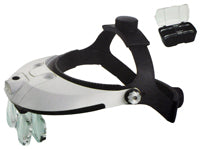
Don't be embarrassed if you get the names wrong, nearly everyone confuses a loupe with an eyeglass, most people refer to 'the flat magnifier' when they mean Fresnel, or 'the thing you stick round your head' when they mean binocular magnifier (also known as a headband magnifier).
Here are the correct names.
Any magnifier large enough to read text (e.g. newspapers, tins in a supermarket) is a 'reading magnifier'. Some are large with handles (readers), some fold or slide into cases (general purpose folding magnifiers), some are small (30mm across), some are large (a few inches across). One interesting variation is the 'Fresnel' (pronounced Fren-nel because it's French), a flat sheet of magnifying plastic, the size can be credit-card size up to page-size. Whatever the variation, these can all be called 'reading magnifiers'.
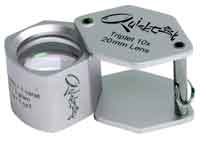
A loupe (pronounced 'loop' in the UK) is a small folding magnifier (from 12mm to 21mm diameter) of high magnification (usually about 10X) which folds into a metal or plastic case. These are used by jewellers for reading small hallmarks or for examining diamonds and gemstones. They are often called jewellers' loupes.
An eyeglass (often called a watchmakers' eyeglass) is a cone of plastic with a lens at the end, you hold the open end in your eye (it takes practise!) and this leaves your hands free to work. Some people (especially on the internet) use the word, 'loupe' for any head-worn magnifier.
Loupes tend to be of better quality than eyeglasses, as they are used for evaluating gemstones and diamonds or detecting the more 'difficult' forgeries in stamps and coins; loupes are easier to use than eyeglasses, you don't have to hold them in your eye.
Most of the magnifiers listed above come in hands-free versions, for instance: eyeglasses that clip to spectacles and large readers on stands (with or without lights) and binocular headband magnifiers that fit around the head.
Apart from deciding on the APPROXIMATE magnification (2X or 10X) and APPROXIMATE size (pocket-size or page-size) and APPROXIMATE quality (£3.00 or £100.00) there is no rule about which type of magnifier to use. Some professional jewellers and engineers buy the cheapest largest reading magnifier because they don't like to spend money; some hobbyists will spend ££110.00 on a Zeiss 10X20 loupe because they want the best. Similarly, for the partially sighted, we have plenty of reading magnifiers at under £5.00 and plenty at over £30.00 (all low magnification, the price increases with the quality of the lens rather than the magnification).
HOW TO USE A MAGNIFIER
With a large magnifier (e.g. for reading books and magazines) hold the magnifier part way between your eye and the object. Now move the magnifier very slowly backwards and forwards until you have the best image, not too small, not too fuzzy. The idea with large reading magnifiers is to sit up straight, sit comfortably, and you shouldn't have to bend over the magnifier and peer closely.
With the most powerful magnifiers (e.g. jewellers loupes) hold the magnifier as close to your eye as possible (if you wear spectacles you may leave them on or take them off, whichever is the most comfortable). Then bring the object very close to the magnifier, so close that it's almost touching. Finally, very slowly move the object away until it is in focus.
With 'in between' magnifiers such as magnifiers for the partially-sighted, or folding pocket magnifiers, move the magnifier slowly backwards and forwards until you have the best image, not too small, not too fuzzy (same as described above) but then move your eyes close-ish to the magnifier. Some of the up-market magnifiers by Zeiss, Schweizer have both measurements printed on them: how far to hold the magnifier from the object and how far to hold your eye from the magnifier. But you don't really need instructions, just experiment, you will find that moving the magnifier and your eyes slightly will make a dramatic difference to what you see.
LIGHTING
Lighting is as important as magnification, as important as quality, without good light you won't see much, even with the most expensive magnifier. Ideally you need bright daylight or bright diffuse ceiling lights, or a table light close to the object. The light must be between the magnifier and the object, do not shine the light at the top of the magnifier, you will merely be blinded by reflections.
If you are a trader buying at pre-dawn fairs or viewing in dimly-lit auction halls, you will benefit from a magnifier with a built in light; if you are partially-sighted and don't have a correctly-positioned table light, then you must use a magnifier with a built in light.
Magnifiers with built in lights come in large sizes (reading magnifiers) or small sizes (jewellers loupes or a watchmaker's eyeglass). For hands-free use, there are magnifiers that fit around the head or clip-to-spectacles or plug into the mains.
THE RULES AND THE MATERIALS
Two rules.
Firstly, size and weight. Large lenses made of glass are heavy whereas plastic is lightweight. Of course, plastic scratches easily, glass doesn't. But don't think that a lens has to be made of glass to be any good, the most expensive lenses (e.g. Zeiss) are made of plastic, although 'plastic' sounds too down market so we say "high grade optical acrylic".
Secondly: magnification, size and working distance. The more powerful the lens, the smaller it will be and the closer you must hold it to the object ('working distance') and the closer you must hold it to your eye. The less powerful the lens, the larger it will be and the further you can hold it from the object (and from your eye). Read that again, memorise it - it applies to all simple-lens magnifiers. There is always a compromise between high magnification (small lens) and large lens (low magnification).
These are the rules. They are not my rules. They are the rules of physics, there is no way around them if you want a simple handheld lens.
QUALITY AND PRICE
When you look through a lens don't simply marvel at 'how large' everything appears. Look to see if faint objects show up against the background or are 'grey'; if straight lines appear straight or curved; if the image is clear around the edges of the lens or wobbly; if colours are true. Lighting is important too. If you are using an illuminated magnifier, is the light bright enough, and does it actually illuminate the object or is it pointing in the wrong direction? These are the differences between the cheapest and most expensive lenses.
If you buy by mail and the magnifier turns out to be unsuitable, you can return it. Or you can see for yourself by visiting us at the office. Please don't be shy about bringing any existing magnifiers to compare, if you are struggling with a £5.00 magnifier and want something better - bring it to compare.
We are specialist optical dealers and very fussy about the quality of our triplet (and 4-element) loupes. We have samples from a supplier who is falsely claiming their loupes are 'triplets' - they are not, and you can see immediately that they are very poor optical quality (click here to see why). If you just have bought one of these (from someone else) buy one of ours, compare the two, and return the one you don't want. Similarly there are many markets where you can buy lenses marked "10X" and "30X" magnification and even "Zeiss" - they are not as described, but unless you have seen the genuine article you will never know just how awful they are.
BASIC TECHNICAL STUFF: MAGNIFICATION AND WORKING DISTANCE
The following applies to simple lenses, including all jewellers loupes. The following does not apply to 'surgeons' magnifiers which are made of two small telescopes, neither does it apply to microscopes.
THE 14-INCH RULE
Some magnifiers are marked with the magnification, some are marked with the focal length (working distance) in inches.
The focal length (working distance) is the ideal distance between the lens and the object, not too close (or the lens won't magnify) and not too far (or the image appears wavy). And if you hold the lens much too far from the object, the image will appear upside down.
Most people don't understand 'focal length' and so when they see a '3' (for some reason eyeglasses are usually marked like this) they think it means "3X magnification" when it really means "three inch focal length". Matters are made worse by the fact that some manufacturers are 'approximate' in their calculations, you can measure the working distance of a 3" magnifier and find it is nearer to 4".
So what is the relationship between focal length (working distance) and magnification? Here is the way we used to calculate it.
If you take a 'normal' working distance for reading to be 14", then a 7" magnifier brings you twice as close = 2X magnification. This '14 inch rule" is what we used , long ago, to calculate magnification and the arithmetic works out like this:
1.5 inch = 9.3X magnification
2 inch = 7X magnification
2½ inch = 5.5X magnification
3 inch = 4.5X magnification
3½ inch = 4X magnification
4 inch = 3.5X magnification
5 inch = 2.8X magnification
6 inch = 2.3X magnification
7 inch = 2X magnification
8 inch = 1.8X magnification
9 inch = 1.5X magnification
With the '14 inch rule" the numbers convert nicely from inches into more-or-less whole numbers for 'magnification', as you see from the chart above.
THE 10 INCH RULE
Then we discovered that according to the almighty Wikipedia, 'normal' working distance for a lens (for reading) is 10 inches, and this is the way we calculate magnification now, see our Magnification Calculator:
1 inch = 10X magnification
2 inch = 5X magnification
2½ inch = 4X magnification
3 inch = 3.4X magnification
3½ inch = 2.8X magnification
4 inch = 2.5X magnification
5 inch = 2X magnification
6 inch = 1.7X magnification
7 inch = 1.5X magnification
8 inch = 1.3X magnification
9 inch = 1.1X magnification
These numbers aren't as good as the old "14 inch rule". For instance, both a 3½ inch and a 4 inch lens have a magnification of about 3X. And both a 5 inch and a 6 inch lens have a magnification of about 2X. And we get customers who think we're being evasive when we describe two eyeglasses as being, "about the same magnification".
If you would like to try out different focal lengths and magnifications to see how they convert (using this "10 inch rule"), go to our Magnification Calculator (it's an Excel download).
WHAT DO OPTICIANS AND SCIENTISTS SAY?
This entire system of magnification being "how many times bigger than normal" (or "X magnification") mystifies opticians. What is 'normal'? It varies from person to person. For an optician, a lens has a focal length - a number that can be calculated, not a 'magnification relative to normal'. If you really want a definition of 'normal' you should use the standard distance (focal length) used by physicists: 1 meter. But by this definition you need awfully long arms to hold a 'normal' lens in one hand and a book 1 meter away in the other hand.
Also, the human eye often requires more than 'just a bit of help with magnification'. That is why you go to an optician - because they have spent years studying optics rather than reading an entry in Wikipedia. We are not an opticians However, the following is a to guide help you through the more technical mysteries of magnification.
MORE TECHNICAL STUFF
The following calculations apply to simple lenses, including all jewellers loupes. The following does not apply to 'surgeons' magnifiers, which are made of two small telescopes, nor to microscopes.
FOCAL LENGTH, DIOPTRES AND MAGNIFICATION
"Working distance" is the same as focal length.
The focal length is the distance you hold the lens from the object that gives the most magnification and the clearest image; it is also the point at which a distant bright object (e.g. the sun) makes the smallest image (e.g. to make a fire using the sun); it is also the distance at which you can project a bright scene onto a surface (stand in a dimly-lit hallway and project the image of a bright window onto the wall). Try it with any magnifier, the distance from the lens to the object will be the same with each of the above experiments, this is the focal length of the lens. In practical terms we can also describe this as, "the [ideal] working distance."
The dioptre is the measurement used by opticians and lens-makers, it is more reliable than defining magnification as "how much larger than normal" an item appears". This is because "normal" varies from person to person (there is no rule that says you have to hold a book ten inches from your eyes!)
'Dioptre' is the reciprocal of the focal length. To write this as a formula, call the magnification M (if you prefer you may say P for power rather than M for magnification...but let's keep things simple) and the focal length f (in meters not inches) which gives: M = 1 / f.
The above formula works beautifully for small powerful magnifiers such as jewellers loupes and small readers. For instance, for a magnifier with a focal length of 30mm: 1 / 0.03m / 4 = X8.33 magnification. But this formula is based on two assumptions:
a) that the object is held at the 'ideal' distance from the lens (its focal length) to give maximum magnification
b) that the lens is held very close to your eye so that your eyes are focusing into the distance (at infinity).
This doesn't work for large lenses with long focal lengths. For instance, if we apply the formula to a large reading magnifier with a focal length of 500mm we get 1 / 0.5m / 4 = X0.5 magnification. Oh dear, that can't be right, it looks as if makes the item appear smaller, not larger! In a sense, this is true, if you place an object 500mm from the lens and hold the lens against your eye, it won't magnify at all. What you must do is move the object closer than 500mm from the magnifier (the magnification will be less) then move your eye away from the magnifier. Your eyes are no longer looking into the distance (infinity) but are focusing closer.
To allow for this there is another accepted formula for calculating magnification: D / 4 + 1.
Applying this to our magnifier with a 500mm focal length, we now get 1 / 0.5m / 4 + 1 = magnification X1.5, which is more plausible.
A well-known optical company (Schweizer) used the first formula, above (D / 4). As a result, most of their magnifications were listed as being less than one, indicating that they made everything appear smaller rather than larger. We use the second formula D / 4 +1 which contradicts their leaflets but at least makes sense.
The famous optical company Zeiss produce a standard 10X jewellers loupe with two lenses, they fold out and can be used individually or on top of each other (the two magnifications simply add together). At one time they quoted the magnification of the two lenses as 6.66X + 3.33X = near enough 10X when used together; then it became 6X + 4X = 10X; now they label it 3X + 6X = 9X. I really don't think they have been changing the lenses each time, the slight variations are due to the way they calculate 'magnification' then round the figures up or down.
All of these figures for 'magnification' are approximate, and there are many reasons for this.
Firstly, it depends which formula you use (see above).
Secondly, if the result looks clumsy (e.g. a magnification of X8.333) the supplier will round it up or down.
Thirdly, how much closer than your 'normal' reading distance an object appears depends on what is 'normal' for you.
Fourthly, when you use the "10 inch rule" (scroll up for explanation) the result won't be exact, because optics experts/designers use a 'standard' focal length (for reading) of 250mm* which is isn't exactly 10 inches. [* this is for the sake of neat arithmetic, physicists use 1m as their 'standard' focal length and 4X250mm = 1m. And that is why, if you scroll back up, you will see a formula that divides by 4]
Fifthly, even when you go to the trouble to measure the focal length and calculate the magnification, you will often find that what is printed on a magnifier is simply wrong.
If you think this is all a little confusing, it is. In fact, it's very confusing. For instance, if you place the object too close to the lens (less than its focal distance) the magnification will be less, and if you hold your eye away from the lens, the magnification will appear to be more.
Confused? You just want to know the answer? See my magnification calculator.
IF YOU WEAR SPECTACLES
If you wear spectacles, should you keep them on whilst using a magnifier?
When using a large magnifier (e.g. for reading) the answer is: yes. I assume, here, that you need a magnifier because the print / map / mark is exceptionally small and you need that extra help in addition to your spectacles.
When using a small magnifier (e.g. a jeweller's loupe or watchmaker's eyeglass): do whichever is the most comfortable, but you must keep the magnifier as close to your eye as possible.
The only time you may wish to think about whether to keep your spectacles on or take them off is if you are wearing a magnifier over your head (a binocular headband magnifier), they can be used with or without spectacles, as follows:
If you are short-sighted (you have difficulty in seeing far objects, your spectacle lens prescription has a power beginning 'minus') you will notice that when using the magnifier without your spectacles the working distance is less than marked on the magnifier. If you are very short-sighted you will also notice that if you don't use a magnifier you can focus on very close objects - you have magnifying eyes for close objects (the only drawback being that you can't focus on far objects). The consequence is that with a binocular magnifier you may choose between two magnifications: one (weaker / further away) when you wear the magnifier over your distance spectacles and one (closer / stronger) when you wear the magnifier without spectacles, whichever you find the most comfortable.
If you are long-sighted (you have difficulty in seeing near objects, your spectacle lens prescription has a power beginning "plus") you will notice that when using the magnifier without your spectacles, the working distance is more than stated on the magnifier. If you are very long-sighted you will also notice that a low-power magnifier doesn't actually magnify at all, it merely brings close objects into focus at a 'normal' viewing (e.g. reading) distance, which is exactly what your reading spectacles do, they are low-power magnifiers. The consequence is that with a binocular magnifier you may choose between two magnifications: one (stronger / closer) when you wear the magnifier over your spectacles and one (weaker / further away) when you wear the magnifier without spectacles, whichever you find the most comfortable.
WHICH IS THE 'BEST' MAGNIFICATION
Between 1.2X and 2X for general reading (for 'just a bit of help') but 2.5X to 4X if your sight is severely impaired (once you get to about 5X the lens will be small and you will only see one or two words at a time). .
Between 3X and 6X for 'general' use, for reading very tiny print on jars, the 'small print' on legal documents, small marks on glass and porcelain and furniture, prints, paintings and photos.
10X (though you could choose as low as 8X or as high as 15X) for hallmarks, gemstones and diamonds; for detecting forgeries in stamps and coins; for seeing the grain in prints and photos or the threads in fabric.
Scroll down for our more detailed recommendations.
CONCLUSION
If you are buying by mail I hope the above will help you make your choice and, as with any item bought from us by mail unseen, you can return for exchange, credit or refund (your choice) providing it is returned in its original condition within fourteen days. We even provide a prepaid address label.
If you are visiting the QUICKTEST to try out some magnifiers, bring with you something familiar, e.g. a coin or stamp if you are a coin or stamp dealer, a book, photograph, print etc. If you have an existing magnifier and wish to upgrade, bring it with you so that you can compare - we will not be offended, if your existing magnifier is better than anything we have, we will be eager to know where you got it!
We help thousands of people choose magnifiers, we really do understand magnifiers. However, we are not opticians, we cannot comment on your spectacle prescription; we are not doctors, we cannot comment on your eye condition; you must consult an optician or doctor if you have concerns about your eyes.
RECOMMENDATIONS
If you go to our main page for magnifiers you can tick lots of boxes to narrow down which type of magnifier you want. You may wish to do that, rather than read the following.
For the partially-sighted - you may wish to read a separate article about magnifiers for the visually impaired.
If you are registered blind or partially-sighted. fill in our form (you can return the form by post or by email) so that you don't have to pay VAT. If you do not consider yourself 'partially-sighted', keep reading.
For map reading in the car, especially at nightime any of the large illuminated readers are good. I keep, in my car the largest hand magnifier for reading a paper map. For those frustrating details on printouts that are just too small to see, I use a Shweizer. A budget version of these is the square lens with four LED lights, the 2X-80X80. I know most people have sat-nav these days, but they do fail, especially when your phone battery goes flat or you lose the signal at a critical moment - so always keep a paper map and a magnifier in the car for emergency.
For carrying in the pocket for occasional reading, e.g. the labels on supermarket products, the 'small print' on forms, those horrible photo-reduced instruction sheets there's a large selection of small folding magnifiers that fit neatly in the pocket. The smallest is the credit-card size Fresnel, buy a few, keep one in each wallet / pocket / bag.
For sewing, embroidery and craft work any of the hands-free magnifiers on stands are good, or the type you wear around the head or which clip to spectacles or which can be worn around the neck. Moving up-market, there are various 'spectacle-type' magnifiers (some of these are for distance, some are for close-up work).
For model-making, fly-tying, clock repairing and other engineering jobs including lathe work the stand magnifiers listed above are good, but you might also consider a head-worn magnifier, from the simple headband magnifier to the expensive surgeon's type magnifier.
For stamps & coins, prints & postcards, fabrics and anything else small and flat there are three options. Firstly, the most popular is any loupe (with or without a light) or eyeglass, especially if you are out-and-about. Secondly, for sitting comfortably, the smaller stand magnifiers and the folding linen testers are good. The linen tester ('linen prover') was traditionally used for measuring the threads-per-inch on linen, but nowadays is used for stamps and coins. Or (the most powerful) for seeing the dots that make up the printing, a pocket microscope. All of these are for flat objects, where the magnifier rests on top. Thirdly, for prolonged use on in a laboratory use a professional microscope (and we sometimes have secondhand microscopes).
For jewellery, gemstones and very small marks on antiques, also insects and plant samples choose any jewellers' loupe (with or without a light) or an eyeglass. Traditionally 10X magnification is used by gem and diamond dealers, a magnifier will be your most important tool, buy the best you can afford. For larger marks (e.g. on porcelain and furniture) any folding magnifier should suffice.
Decorative magnifiers / gifts: I don't really sell magnifiers 'just for decoration', but you could try the pendant magnifier.
Spare parts: see bulbs, pouches, chains etc for magnifiers.
Click here to see all categories of magnifier
RELATED ARTICLES
- How to choose a jewellers' loupe (including examples of what you will see through loupes)
- How choose a binocular headband magnifier (from simple hobby model to a professional surgeon's / dentists models)
- How to choose a magnifier for the partially sighted (specialist low vision aids including lenses and video magnifiers)
- How to choose a UV loupe (ultra violet light)
- Calculator (Excel format) - enter the magnification, it tells you the working distance, or enter the working distance, it tells you the magnification.
- How to choose a stereo binocular microscope (all sizes and magnifications)
- Professional USB microscope attachment (it replaces the eyepiece of your microscope)