


Screws for spectacles and watches
Screws for fixing spectacles and all about screws and screwdrivers.
Types of screws, types of screwdrivers, which screws fix spectacles, screws for clocks and watches.
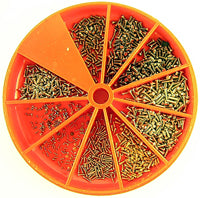


BUY NOW: CLICK ON THE PICTURE
CONTENTS
COLOURS
SCREW TYPES
HEAD TYPES
RELATED ARTICLES (jewellery and horology)
COLOURS
The colours vary from a dark steel colour to a very light (but still steel-like colour), we don't think any of them are made of brass. This photograph makes them appear more 'gold' than they really are, probably because of the light reflecting off the orange container.
SCREW TYPES
If you thought there were only two types of screwdriver, flat (for slotted screw heads) and cross-head (for Phillips and Pozidriv) - think again! There are ten basic types of screw / screwdriver, and also a dozen different shapes of screw head.
A good place to see pictures and descriptions of each is Wikipedia - and you will also find a summary of the various screw-size-classification systems (Whitworth, BA etc).
HEAD TYPES
- Flat-head
Flat screwdrivers (for slotted screw heads) are the most common of all, especially for spectacles and watches. We sell specialist small sets of screwdrivers for very tiny objects - if you want larger screwdrivers go to your local DIY store.
For watchmaking the thickness of the blade should fit the width of the slot exactly. Since you can't buy screwdrivers in different thicknesses, a watchmaker will re-grind the blades. Very 'sharp' blades in very 'wide" slots are very difficult to handle.
- Cross-head
The Phillips screw has slightly rounded corners and is designed so that the screwdriver will slip out ("cam out") under turning-pressure ("torque"). This is to prevent over-tightening. So when customers complain that our screwdrivers are no good because they keep slipping out of the screw - they're meant to!
There are other varieties which do not cam out: the Reed and Prince and the Frearson have 'sharp' crosses and, similarly, the Pozidriv has four extra points which make it star-shaped. Another cross-shape that does not cam out is a BNAE, a tiny screwdriver-head in the form of a 'bit' for a power tool.
See all screwdrivers and screws.